
Software development with AI: how we work
Published · 4 min read
Listen to the article · read by an AI voice
Software development with AI is part of everyday work at epicsoft. We bring more than 20 years of experience in software development, consulting and IT operations, and today an AI takes part in almost every step: writing code, testing, running our servers and writing texts like this one. What has not changed is who carries the responsibility: a person. This article shows how we organise it, what you gain as a client and where we deliberately set limits for the AI. As of November 2026.
Software development with AI: humans and AI as a team
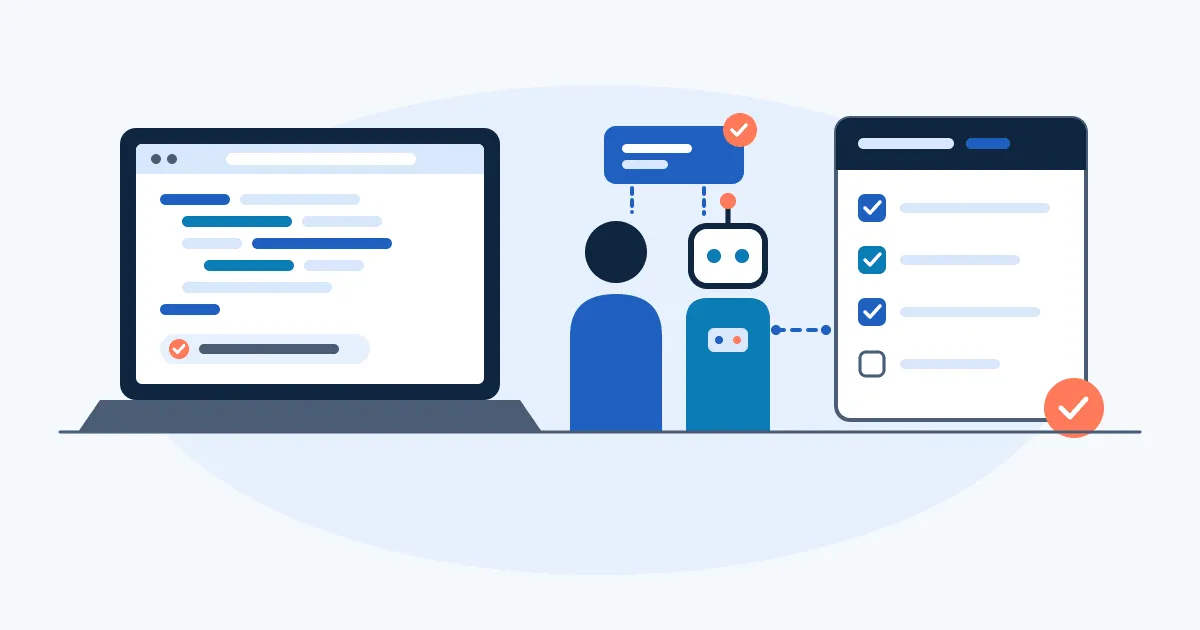
At epicsoft, the AI is not an autopilot but a team member with clearly defined tasks:
- People set goals and priorities, decide on architecture, security and cost, give approval and are your point of contact.
- The AI writes and reviews code, adds tests, analyses logs, keeps dependencies up to date, documents and translates.
Experience sets the direction, the AI speeds up the work. That is also how the section “Humans and AI as a team” on the About page of epicsoft.one puts it.
Every task with a clear brief
Larger projects start as a ticket: the goal, the scope as a checklist, open questions and the decisions taken. Work begins only once no question is left open. That forces clarity before the first line of code is written.
Several tasks run in parallel, each in its own separate workspace. They do not get in each other’s way, and each can be checked on its own. Before a task comes back, the AI checks its own work: code review, test coverage, a comparison with the ticket. It ticks off what is done and names what is still open. Nothing is taken over until a person has approved it.
Approvals and limits
An AI can be wrong and still sound very sure of itself. The US National Institute of Standards and Technology (NIST) lists such “confabulation” as a risk of its own in its profile for generative AI. We treat this as a fact, not an exception, and have shaped the way we work around it:
- Check first, then claim. A statement about code, servers or data needs evidence: a test, a log, a measurement.
- Changes only with approval. Anything that changes servers, DNS records or other systems happens only with a person’s approval – case by case, or as a fixed rule for clearly defined routine.
- Credentials stay locked away. Keys and passwords are kept in a central vault, not in code. The AI fetches them only for the single call and never displays them.
A memory for the whole team
Our AI assistants start every session without any memory of the previous one. So we write down what matters: decisions, rules and lessons learned are kept, with their reasons, in a shared memory. The next session knows them, even when a different role takes over the task. Nothing that has been decided needs deciding twice, and what went wrong once is noticed earlier next time.
Measure before we promise
We only offer new AI features once we have measured them. One example is reading receipts automatically, which we are testing at the moment: we compare text recognition and AI models on test receipts in German, English, Russian and Georgian, by accuracy and by time per receipt. What goes into a product is decided by the measurement, not by the impression a demo leaves.
What you gain
- More speed on routine work. Updates, tests and documentation run alongside; our time goes to the questions that need experience.
- Traceable changes. Updates are documented with their reason and a way back, and code changes are tied to their ticket.
- Several languages. Texts and interfaces are written in German, English, Russian and Georgian – just like our websites.
- People as your contact. You talk to people who take responsibility; the AI works in the background.
Using AI in your own company
Would you like to use AI tools in your own development or IT? We help you introduce them safely, with clear limits for access and data. Find out more in the services of epicsoft, or write to us.
Sources
- NIST AI 600-1: Artificial Intelligence Risk Management Framework – Generative Artificial Intelligence Profile (nist.gov), July 2024: section 2.2 “Confabulation” – confidently stated but false content as a risk of generative AI.